
Which Parts Fail When an Oven Is Not Heating Evenly in Prairie Village, KS
An oven not heating evenly is most often caused by a failing bake element, a malfunctioning convection fan, or a temperature sensor that’s providing inaccurate readings to the control board. For homeowners in Prairie Village, KS, this issue can be particularly frustrating when it affects baking consistency or shows up unexpectedly before a planned meal. Understanding which parts are most likely involved can help clarify what a repair might involve before scheduling a visit.
This guide identifies the components most commonly responsible for an oven not heating evenly, how related concerns like oven temperature problems or an oven won’t turn on situation might connect, and what generally affects the cost of repair. Understanding which part is likely involved can make it easier to evaluate a technician’s estimate later on.
Key Takeaways
- An oven not heating evenly is commonly traced to the bake element, the convection fan, or a faulty temperature sensor.
- Oven temperature problems can range from minor calibration issues to more significant component failures.
- An oven won’t turn on is a related but distinct concern that often points to different components than uneven heating.
- Repair costs vary widely depending on which part has failed, from inexpensive sensor replacement to more involved element or control board repairs.
- The age of the oven and frequency of past repairs are useful factors when weighing repair against replacement.
The Bake Element
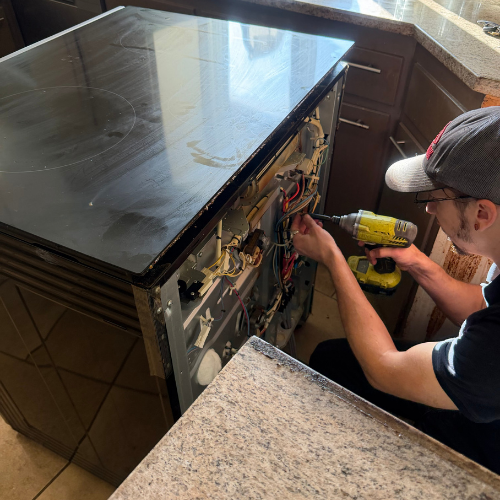
The bake element, located at the bottom of the oven cavity in most electric models, is one of the most frequent sources of an oven not heating evenly. As elements age, they can develop weak spots or partial breaks that reduce heat output in specific areas without failing completely.
Signs of Bake Element Trouble
A visibly damaged element, such as one with blistering, a break, or a bright glowing spot, is often a clear indicator. In other cases, the element may look intact but no longer heat to the correct temperature, which is harder to diagnose without testing tools.
Typical Repair Cost Considerations
Bake element replacement is generally one of the more affordable oven repairs, since the part itself is relatively inexpensive and accessible in most models. Labor cost can vary depending on how easily the element can be removed and replaced, and some models require partial disassembly of the oven’s rear panel to access the wiring connections.
The Convection Fan
Ovens with a convection setting rely on a fan to circulate hot air throughout the cavity. When this fan fails or slows down, heat may concentrate unevenly, contributing to an oven not heating evenly, particularly when using the convection function specifically rather than standard bake mode.
Signs of a Convection Fan Issue
If uneven heating is noticeable primarily during convection baking but not during standard baking, the fan motor is a reasonable first component to investigate. A fan that makes unusual noise or doesn’t spin at all when the convection setting is active is a stronger indicator of failure.
Typical Repair Cost Considerations
Convection fan motor replacement tends to be a moderate repair cost, generally higher than a bake element but lower than more involved electrical repairs, depending on the oven’s make and model. Access to the fan motor typically requires removing the rear panel of the oven cavity, which adds to labor time compared to more accessible components.
The Temperature Sensor
The temperature sensor, typically a metal probe visible inside the oven cavity, measures internal temperature and reports it to the control board. When this sensor fails or reads inaccurately, the oven may cycle the heating element incorrectly, leading to an oven not heating evenly even when the element itself is functioning properly.
Diagnosing Sensor Issues
Oven temperature problems caused by a faulty sensor often show up as an oven that runs consistently hotter or cooler than the set temperature, rather than uneven heating within a single bake. Testing the sensor’s resistance with a multimeter can help confirm whether it’s reading correctly at various temperatures.
Typical Repair Cost Considerations
Temperature sensor replacement is usually one of the least expensive oven repairs, making it a reasonable component to test early when troubleshooting oven temperature problems.
Door Seal and Gasket Issues
A worn or damaged door seal can allow heat to escape during baking, which sometimes presents similarly to an oven not heating evenly, particularly near the door itself. This is a lower-cost repair compared to internal components and is often overlooked during initial troubleshooting.
Inspecting the gasket for visible gaps, tears, or flattening around the door perimeter is a reasonable first step before assuming a more involved internal failure.
When the Oven Won’t Turn On At All
An oven won’t turn on situation is generally a separate issue from uneven heating, though both can stem from control board problems. If the oven doesn’t power on at all, common causes include a tripped circuit breaker, a faulty control board, or, in some cases, a wiring issue that requires professional diagnosis.
It’s worth distinguishing between an oven won’t turn on scenario and an oven not heating evenly, since the former typically points to a power or control issue, while the latter usually involves a specific heating component still receiving power.
Book an Oven Repair Now!
Cost-to-Repair Guidance
Repair costs for an oven not heating evenly vary significantly depending on which component is responsible.
Lower-Cost Repairs
Bake elements, temperature sensors, and door seals tend to be among the more affordable parts to replace, both in terms of the part itself and the labor typically required.
Moderate-Cost Repairs
Convection fan motors and some control board components fall into a moderate range, often costing more than element or sensor replacement but less than a full control board or complete internal wiring repair.
Higher-Cost Repairs
Control board failures, particularly those affecting multiple oven functions or causing an oven won’t turn on, tend to be among the more expensive repairs and are worth comparing against the cost of a new unit, especially on older ovens.
Basic Maintenance That May Help with Even Heating
While not every case of an oven not heating evenly can be prevented, a few habits can reduce the likelihood of certain issues:
- Avoiding overcrowding the oven cavity, which can restrict airflow around the convection fan
- Periodically checking the door gasket for visible wear
- Using an independent oven thermometer occasionally to compare against the display setting
- Cleaning around the temperature sensor probe, since buildup can sometimes affect its accuracy
These steps address some preventable contributors, though they won’t resolve a failed heating element, fan motor, or control board.
Repair or Replace: What to Consider
Age of the Oven
Ovens typically last between 12 and 15 years with regular use. Units nearing or past this range are generally less likely to justify a costly repair, particularly one involving the control board.
Frequency of Past Repairs
An oven that has needed multiple repairs recently, whether for oven temperature problems, an oven not heating evenly, or an oven won’t turn on situation, may be signaling broader wear worth factoring into the decision.
Comparing Repair Cost to Replacement
Weighing the estimated repair cost against the price of a comparable new oven is a reasonable way to approach the decision, particularly when higher-cost components like the control board are involved.
Conclusion
An oven not heating evenly typically points to one of a handful of components: the bake element, the convection fan, the temperature sensor, or, less directly, a worn door seal. Oven temperature problems and an oven won’t turn on situation are related concerns that can help provide useful context, even though they don’t always share the same underlying cause as uneven heating. Understanding which parts are commonly involved, along with typical repair costs, supports a more informed decision for Prairie Village homeowners facing this issue.
Not Sure What’s Causing the Problem?
If you’ve gone through the basics and still can’t pinpoint why your oven isn’t heating evenly, or if you’d rather have a professional diagnose the issue before it leads to further inconvenience or higher repair costs, a diagnostic visit is a practical next step.
The team at Appliance Shark serves Prairie Village and the broader Kansas City metro area, with experience across oven brands and common repair scenarios, including uneven heating, oven temperature problems, and situations where an oven won’t turn on. If you’re ready to get a technician out to take a look, you can Book a Repair directly, no commitment required until you’ve reviewed the estimate and decided how you’d like to proceed.
If the assessment indicates the appliance is beyond cost-effective repair, that’s useful information too. You’re welcome to Visit our Appliance Store to explore replacement options, a straightforward next step if a new oven turns out to be the more practical choice.